Picture the last time you Googled a symptom at 11 p.m. The page you clicked had maybe ninety seconds to convince you it knew what it was talking about. That ninety-second window is the whole job of a medical website. Google labels healthcare pages YMYL, short for Your Money or Your Life, and grades them harder than almost any category online. Patients land worried, often half-confused, and they want clear answers from someone who sounds like they know what they're talking about. The fundamentals behind copywriting in general still apply. Medicine just turns the dial up, which is why agencies offering medical healthcare copywriting services charge what they charge for the work. The good news for beginners: the rules aren't hidden. Once you can spot what trust looks like on the page, you can build it sentence by sentence.
TL;DR Quick Answers
Medical Healthcare Copywriting Services
Medical healthcare copywriting services produce patient-facing content for healthcare websites, marketing materials, patient education resources, and provider communications. The work blends plain-language writing, search engine optimization, regulatory awareness, and brand voice into pages that build patient trust while meeting Google's higher YMYL quality standards for health content.
Practices typically bring in a specialist when:
Launching a new practice or healthcare brand
Redesigning an existing website
Expanding into a new service line
Search rankings have flattened despite consistent content
E-E-A-T signals need strengthening across the site
Top Takeaways
Healthcare pages count as YMYL content, so Google's quality bar lands higher than almost any other niche.
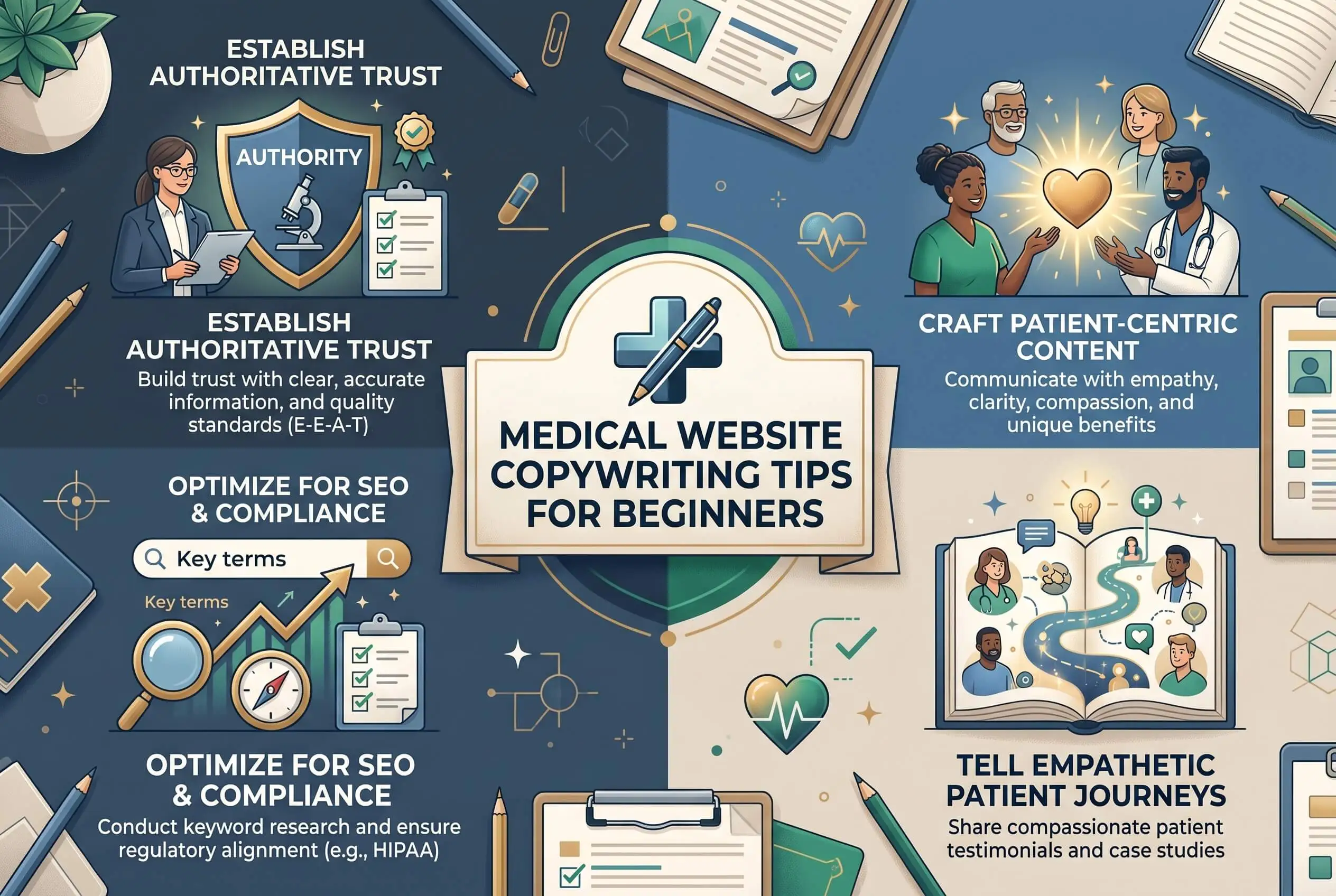
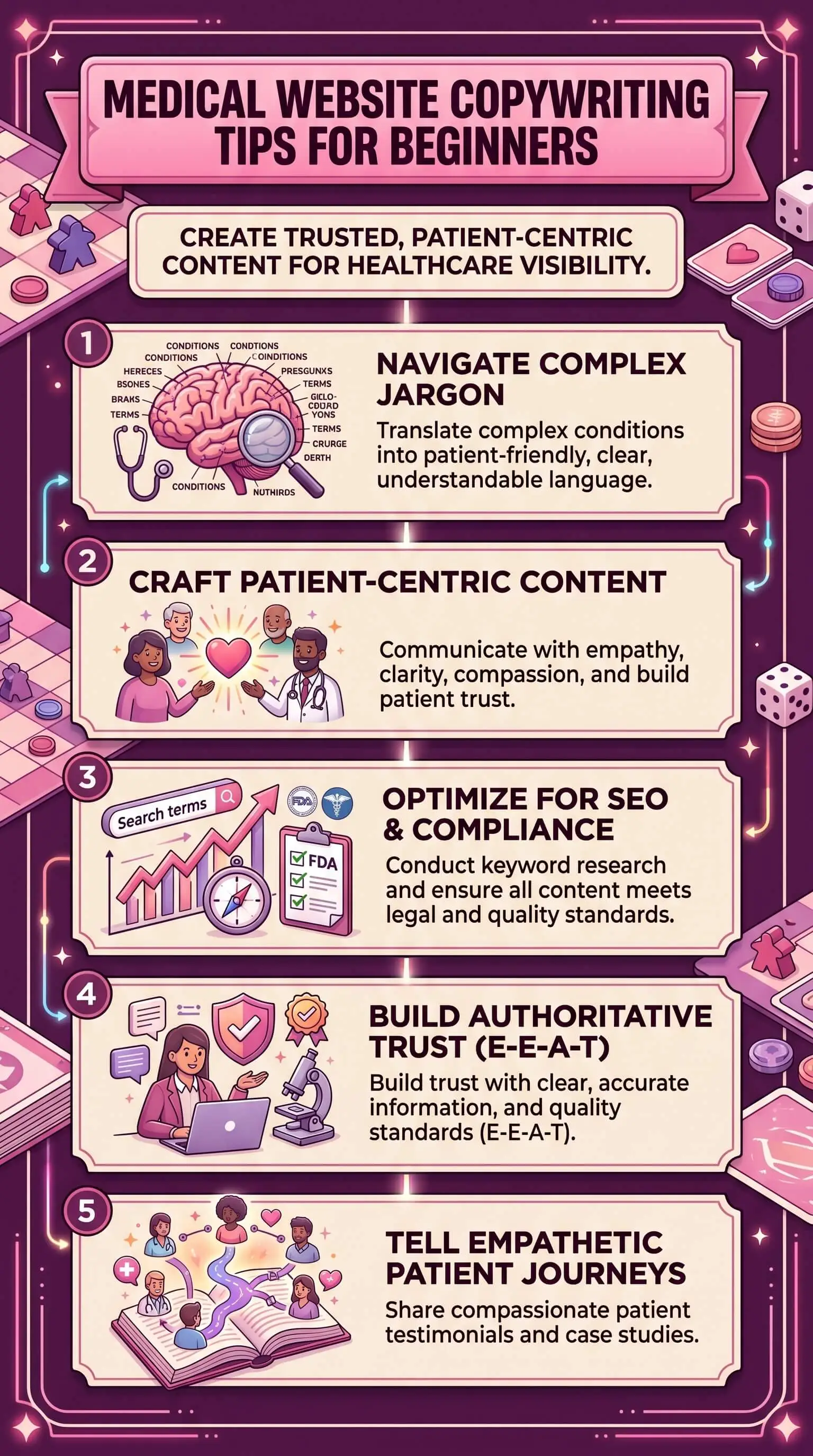
Write for one patient at a time, in plain language, at roughly an eighth-grade reading level.
Lead with patient outcomes, then let credentials back the promise up.
E-E-A-T signals like author bylines, reviewer attribution, and cited sources earn trust from readers and search engines at the same time.
Soft, respectful calls to action outperform pressure tactics in medical contexts.
Know who you're really writing for
Most healthcare pages get read by at least four different people: an anxious patient, a caregiver doing research on someone else's behalf, a referring physician scanning credentials, and an insurance reviewer hunting for keywords. You can't write to all four at once. Pick one. If the page is about chronic wound care, the patient is your reader, not the clinician. Use their words. Ask the questions they're already asking themselves. The other three readers will still get what they need from clear, plain language written for someone else.
Write to an eighth-grade reading level
Most American adults read at or below an eighth-grade level, including plenty of well-educated readers once the topic turns medical. Cut clinical jargon unless your reader is a clinician. Swap polysyllabic words for shorter ones, and break long sentences in half. Read every draft aloud. If you stumble on a sentence, your reader will too. Free tools like the Hemingway Editor and the CDC Clear Communication Index will score your draft in seconds, and any beginner benefits from running new pages through one of them before publishing.
Lead with patient benefits, not credentials
Almost every beginner draft I see opens the same way, with board certifications, years in practice, and awards stacked at the top. That information matters, but the top of the page isn't where it belongs. Patients want to know what changes for them. Compare "Board-certified physician with twenty years of experience" against "Get answers from a doctor who's helped three thousand patients with the same condition." Both signal expertise. Only the second one ties that expertise to something the patient walks away with. Lead with the outcome. Let the credentials back it up.
Build E-E-A-T into every page
E-E-A-T is what Google's quality raters use to score healthcare content: Experience, Expertise, Authoritativeness, and Trustworthiness. Building it in isn't hard. Name the author. Show their credentials. Attach a medical reviewer when the page makes clinical claims. Link to peer-reviewed sources, not aggregators. Add a last-updated date to every page. None of that slows the reader down, and all of it tells both Google and the patient that the page can be trusted.
Respect compliance without sounding like a lawyer
Healthcare copy lives inside legal guardrails whether you acknowledge them or not. HIPAA protects patient information, the FDA polices health claims, and state medical boards watch for anything that reads like a diagnosis. Beginners overcorrect on this all the time, writing in stiff, defensive prose that scares patients off the page. The trick is to learn what you can't say, and then say everything else in plain, warm language. Avoid words like "cure," "guaranteed," and "safe" unless you can back them up with evidence. Run the page past a compliance reviewer before it goes live.
Optimize for SEO without keyword stuffing
A page that repeats its keyword every other sentence will read like spam and rank worse for it. Search visibility still matters, so put your primary phrase in the page title, the first hundred words, one subheading, and the meta description. Then let the rest of the page breathe. Semantic variants do the same SEO work without the spammy feel. A page targeting medical healthcare copywriting services will rank just as well, and it'll read more naturally, if half the mentions become "healthcare copywriter" or "medical content writing services."
Design calls to action around patient autonomy
Healthcare isn't e-commerce. Countdown timers, scarcity language, and aggressive nudges feel manipulative when someone is making a medical decision. The CTAs that actually convert in this space stay quiet and respectful. "When you're ready, schedule a consultation." "Have a question before you book? Send us a message." Both let the reader feel in control, which is exactly the emotional state that makes them more likely to act. Pressure tactics work in other categories. In medicine, they erode the trust you just spent the whole page building.
“After roughly a decade of writing for healthcare brands, the same pattern shows up project after project. The practices that win online win on voice, not on slogans or design. Their web copy reads like an actual person who knows medicine and happens to be talking to you, in a calm voice and plain language, informing harder than it sells. Beginners who get that one principle, write like a knowledgeable friend rather than a pamphlet, sit ahead of half the medical websites currently online.”
7 Essential Resources
Bookmark these. They make up the working library behind most professional healthcare copywriting:
Plainlanguage.gov. Federal plain language guidelines maintained by the U.S. government. The clearest single resource on writing for non-expert readers.
CDC Clear Communication Index. A research-based scoring tool from the Centers for Disease Control and Prevention that grades health content on twenty criteria. Run a draft through it before you publish.
NIH Health Literacy resources. The National Institutes of Health's primer on writing for patients with varying reading and comprehension levels.
Google Search Quality Rater Guidelines. The official document Google's human evaluators use to score search results, and the original home of the E-E-A-T framework.
AMA Manual of Style. The American Medical Association's reference for medical writing conventions. Useful when you need to settle a style question or check terminology.
Hemingway Editor. A free readability tool that flags long sentences, passive voice, and overly complex words. Fast and beginner-friendly.
Wikipedia overview of copywriting. The foundational definition and history. Worth reading once to anchor the broader discipline before you specialize.
3 Supporting Statistics
Numbers that should shape how you write every healthcare page:
Only 12% of U.S. adults have proficient health literacy, according to the U.S. Department of Health and Human Services. Nine out of ten readers struggle with content written above a basic level, which means plain language stops being optional in this niche.
Seventy-seven percent of online health seekers start their research at a search engine, according to Pew Research Center. A page that isn't optimized for search is invisible to the audience most likely to convert.
Eighty-four percent of patients check online reviews before booking care, and more than half read at least six reviews before making an appointment, per a 2026 survey reported by Medical Economics. Copy and reputation work together, not separately.
Final Thoughts and Opinion
Clever wordplay is the wrong instinct for medical copywriting. The job is earning trust under tighter rules than almost any other writing niche, and most beginners try to master every rule before publishing a single page. That's also the wrong instinct. A top marketing and advertising firm understands that the strongest healthcare content builds credibility first, helping practices connect with patients through clear messaging, trustworthy information, and a professional online presence that reflects the quality of care they provide. Start with one principle: write like patients deserve to be talked to, not at. Layer the rest over time. The practices that show up in search results five years from now will be the ones that respected their readers from day one.
Frequently Asked Questions
What does a medical copywriter actually do?
A medical copywriter writes patient-facing content for healthcare websites, marketing materials, patient education resources, and provider communications. The work blends plain-language writing, search engine optimization, regulatory awareness, and brand voice into pages that build patient trust and meet Google's higher quality standards for health content.
How is medical copywriting different from regular copywriting?
Medical copy carries three burdens that other niches don't: a lower reading level requirement, stricter compliance rules, and real consequences for getting it wrong. A misleading product page might cost a sale. A misleading medical page can cost a patient. That asymmetry is why the work pays well, and why specialists exist.
Can I write my own healthcare website copy as a beginner?
Yes, and many small practices do, especially in their first year. The principles in this article will get you most of the way there. The catch is that medical copy compounds: small mistakes early on quietly suppress your search rankings and patient trust for years. Beginners can do good work. Plan to revisit every page once you know more, though.
What are the most common medical website copywriting mistakes?
Four mistakes show up over and over: leading with credentials instead of patient benefits, writing at a college reading level when patients read at eighth grade, stuffing keywords until the page reads like spam, and hiding the author. The author-byline mistake is the least obvious of the four, but pages without one lose E-E-A-T points and patient trust at the same time.
When should I hire professional medical healthcare copywriting services?
Bring in a professional once the stakes get higher: launching a new practice, redesigning a website, expanding into a new service line, or watching search rankings flatline despite consistent content. A specialist like Riley James Copy's healthcare copywriting services can shorten the learning curve and protect your E-E-A-T from day one.
CTA
You're already past most healthcare brands writing their own copy. Pick one tip from this article and apply it to your next page. Layer the rest in as you go. When the stakes climb and you want professional support, a specialist copywriter can shorten the learning curve and keep your E-E-A-T compounding from the first page forward.