You don't need a crisis to justify seeing a therapist for anxiety. Once worry is taking your sleep, shrinking your plans, showing up in your body, or keeping you braced for weeks at a time, it already counts.
Anyone who cares for wounds for a living learns that the mind shows up in the skin. A person under long strain often heals more slowly, which is one reason some wounds take longer to heal than the chart says they should. Worry is never only in your head.
I'm Lauren Rath, a Mental Health Counselor licensed in Washington. For seven years I've practiced Internal Family Systems therapy, and almost every anxious adult who finds me waited longer than they needed to, usually by months and sometimes by years.
They kept telling themselves it wasn't bad enough yet.
If you're reading this, some part of you has started to wonder. I'd listen to it.
TL;DR Quick Answers
Therapist for Anxiety in Spokane, WA · IFS Therapy
Lauren Rath, MA, LMHC, is a Spokane-based Mental Health Counselor licensed in Washington who treats adult anxiety with Internal Family Systems (IFS) therapy over secure video anywhere in the state.
Who it's for: Adults whose worry is costing them sleep or keeping them braced most days. No crisis or diagnosis required.
How IFS helps anxiety: It treats anxiety as a protective part of you rather than a flaw, and that part tends to ease once it feels heard.
Where sessions happen: Online, from home or a parked car, as long as you're physically in Washington during the session.
Training: IFS training through the IFS Institute and seven years of IFS practice.
Insurance: In-network with BCBS, Aetna, Regence, Premera, and Cigna.
First step: A free 15-minute call with no commitment.
Top Takeaways
No crisis required. If anxiety is costing you sleep, relationships, work, or ease, it's serious enough to talk about.
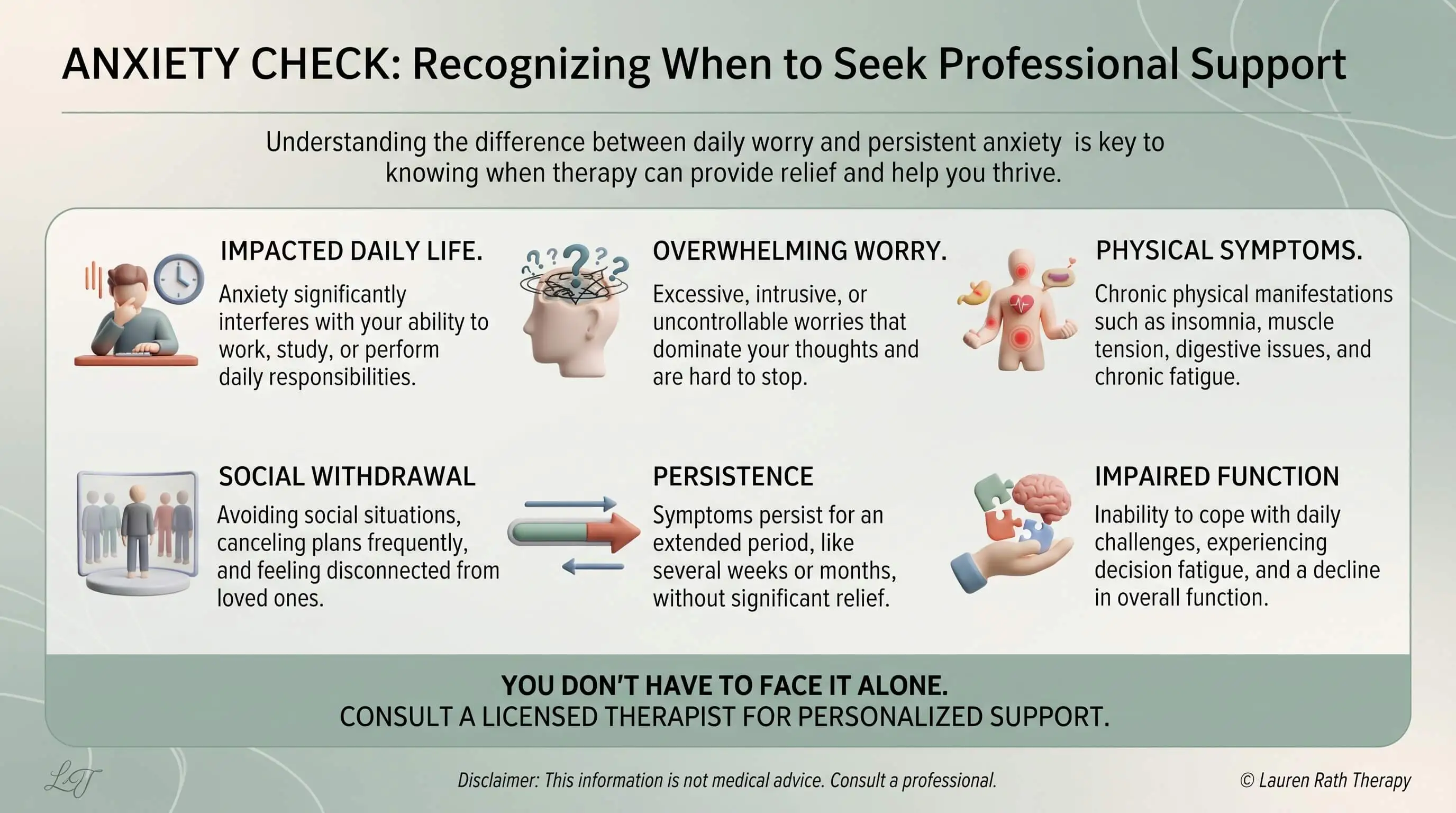
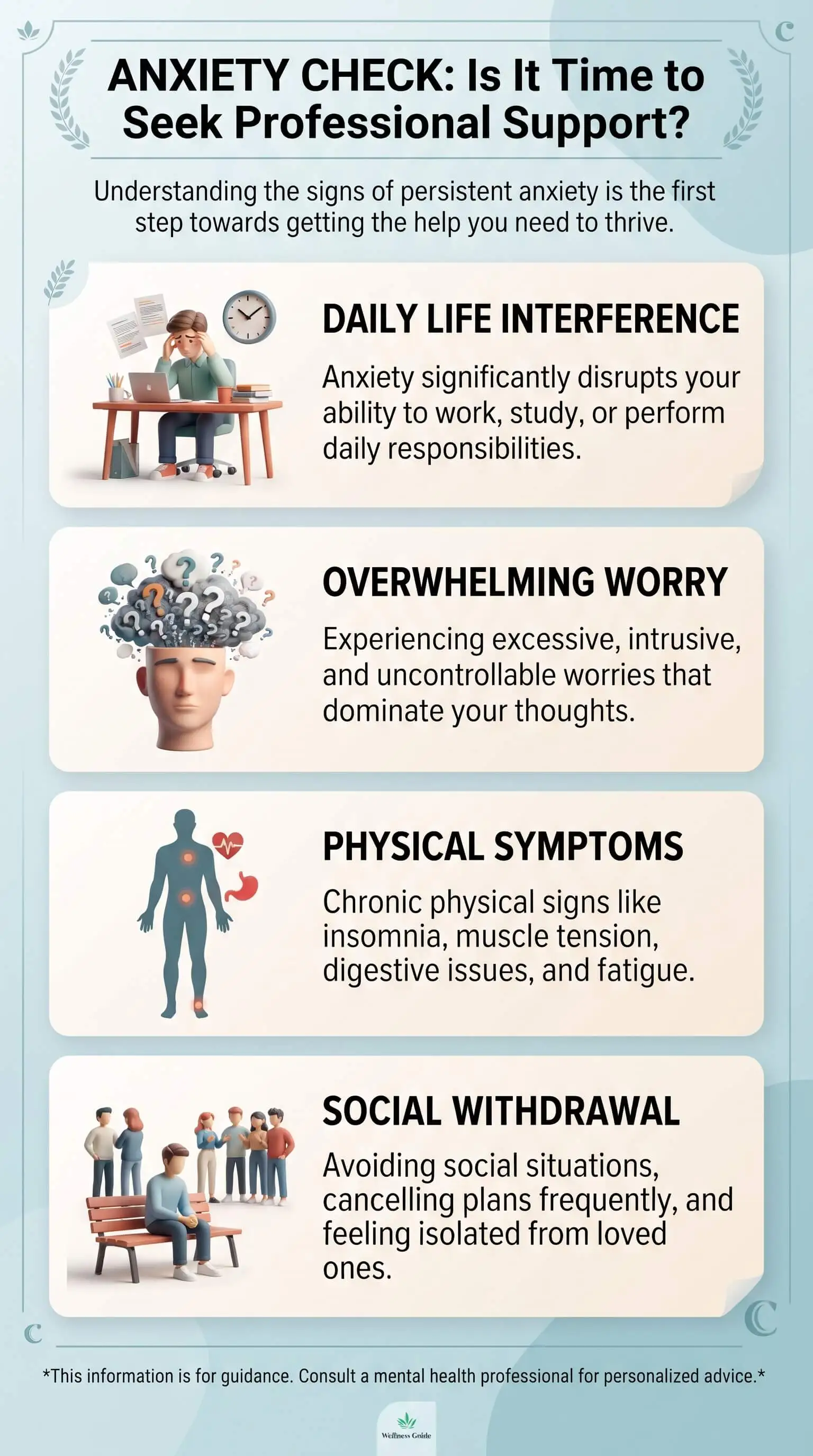
Five signs to watch. Worry that won't switch off, a shrinking life, a body keeping score, coping that has stopped working, and a voice insisting it isn't bad enough.
Your body counts. Chronic stress can slow physical healing, so anxiety never lives only in your head.
The doubting voice is a part. It's protective, and it gets a hearing rather than the final say.
Starting is small. One short call tells you whether therapy fits.
When Worry Stops Being Ordinary
Some anxiety earns its keep. It gets you to the airport on time and has you checking the stove twice before a long trip.
Ordinary anxiety matches the size of the problem, then leaves.
The kind worth bringing to a therapist stays. It drifts from one worry to the next without landing anywhere. You lie awake at 3 a.m. replaying a conversation that went fine, and your jaw is tight before the workday starts.
NIMH describes generalized anxiety as worry that shows up more days than not for at least six months and feels hard to control. You don't have to clear that bar to deserve help. Most of the people I work with never would have called themselves anxious. They'd have said tired, or a lot on my plate.
5 Warning Signs Your Anxiety May Need a Therapist
1. The Worry Doesn't Switch Off
Everyone worries. What matters is whether you can set it down.
When anxiety needs support, it follows you from your desk to the dinner table and into bed. A quiet moment stops being rest and turns into room for the next worry. Maybe you catch yourself scrolling or reorganizing a drawer at 10 p.m. just to keep the noise down.
When was your mind last quiet for a whole evening?
2. Your Life Is Getting Smaller
This one sneaks up on people.
You skip the party because the drive feels like too much. You let calls go to voicemail and pass on the project that would have stretched you. Each choice makes sense on its own day, but together they draw a tighter circle every month.
Anxiety is very good at dressing avoidance up as preference.
What have you stopped doing because of how it would feel?
3. Your Body Is Keeping Score
Anxiety is physical. It shows up as tension headaches, a stomach that won't settle, shallow sleep, and colds that hang on for weeks.
It can slow healing, too. Stress hormones interfere with the early inflammatory phase that starts wound repair, and researchers at Ohio State measured that delay in family caregivers living under long-term strain. If a cut or a surgical site heals slowly during a hard season, pay attention.
Your body may be saying what you haven't said out loud yet.
Where do you feel the worry first?
4. What Used To Help Has Stopped Helping
You've probably tried things already. Walks, breathing apps, journaling, a podcast about the nervous system, maybe a glass of wine that quietly became two.
Nothing about that was wrong. It may just not reach the source anymore.
Once coping turns into a second job you can't take a day off from, you need more support than you can give yourself.
Are your tools helping, or only keeping you afloat?
5. A Part Of You Keeps Saying It Isn't Bad Enough
I see this sign more than any other, and it's the one people miss.
Other people have it worse. I don't want to take a spot from someone who really needs it.
That voice sounds reasonable. In my experience it usually belongs to a protective part of you, one that learned early that needing help made you a burden. It's trying to keep you safe, so it deserves a hearing, though not the final word.
If a friend described your last month to you, would you tell them to wait?
How IFS Therapy Works With Anxious Parts
You already talk this way. Part of me wants to go, part of me wants to stay home.
The Internal Family Systems model, developed by Richard Schwartz, takes that seriously. IFS therapy treats the mind as a family of parts with different jobs, all held around a steady center called the Self.
Seen that way, anxiety is a protector, usually the part that scans every room and rehearses conversations before they happen. It took that job on for a reason, often a long time ago.
So we don't try to silence it. We get curious and ask what it's afraid would happen if it stopped. When a part feels heard, it tends to soften on its own, and I've watched that happen hundreds of times.
Nothing gets forced, and we move at whatever pace your system allows.
You don't have to leave home for this, either. Working with a therapist for anxiety in Spokane, WA · IFS Therapy can happen over secure video from your living room or a parked car, anywhere in Washington.
"Almost everyone who comes to me for anxiety starts by apologizing for taking a spot someone else might need more. I've learned to hear that apology as a part of speaking. Usually it's the same part that has kept them functioning for years, and it's exhausting. When we thank it instead of arguing with it, the worry underneath finally gets room to talk. That's where the work begins."
Essential Resources
Where I'd send a friend who was still deciding.
Learn Where Everyday Worry Ends
NIMH explains how an anxiety disorder differs from ordinary worry. The short version is that the anxiety doesn't go away and tends to grow over time. Hold your own last month up against that description and see where it lands.
Source: NIMH: Anxiety Disorders
See How Stress Slows The Body's Repair Work
Ohio State researchers Jean-Philippe Gouin and Janice Kiecolt-Glaser pulled decades of studies on stress and wound healing into one review. It's dense reading, but their conclusion is plain. Stress has a measurable effect on how fast the body heals.
Source: The Impact of Psychological Stress on Wound Healing
Know What Therapy Is Before You Start
The American Psychological Association explains what a first session looks like and how long therapy usually takes. Read it if part of you is nervous about what you'd be walking into.
Source: APA: Understanding Psychotherapy And How It Works
Sort Out Who Does What
Counselors, social workers, psychologists, psychiatrists. SAMHSA explains which of them offer therapy and which can prescribe medication.
Source: SAMHSA: Types Of Health Care Providers
Check Any Washington Therapist's License
Washington's Department of Health lets you look up a provider's credential and disciplinary history by name in about a minute. Use it on me, and on anyone else you're considering.
Source: Washington DOH Provider Credential Search
Get A Referral At Any Hour
SAMHSA's National Helpline is free and confidential, and someone answers around the clock in English and Spanish. It makes a good first call if you'd like help finding care near you.
Source: SAMHSA National Helpline
Know What Happens When You Reach Out To 988
The 988 Lifeline describes, step by step, what happens when you call, text or chat, including who answers and what they ask first. Knowing the shape of something makes it easier to do.
Source: 988 Lifeline: What To Expect
Supporting Statistics
Three numbers I keep in mind whenever someone tells me their anxiety doesn't count.
You Are Far From The Only One
According to NIMH, an estimated 19.1% of U.S. adults had an anxiety disorder in the past year, and 31.1% will have one at some point in their lives.
Roughly one in five adults in a single year.
Nearly one in three over a lifetime, which means the waiting room is fuller than it feels.
Source: NIMH: Any Anxiety Disorder
Most People Wait
The Anxiety and Depression Association of America reports that generalized anxiety disorder affects 6.8 million U.S. adults, yet only 43.2% are receiving treatment.
Fewer than half.
Cost and waitlists keep some people away. So does the voice insisting it isn't bad enough yet, and that gap is who I wrote this for.
Source: ADAA: Anxiety Disorders Facts And Statistics
Stress Shows Up In The Skin
Ohio State researchers found that women caring for a spouse or parent with dementia took, on average, 24% longer to heal a small standardized wound than similar adults without that strain.
Same kind of wound, different stress load.
Chronic worry costs the body too, and the mind doesn't carry it alone.
Source: Gouin et al., The Influence of Anger Expression on Wound Healing
Final Thoughts And Opinion
Here's where I land. "Bad enough" is the wrong test.
Nobody waits for a wound to get infected before cleaning it, and nobody asks whether a cut is serious enough to earn a bandage. With anxiety, though, people hold out for a breakdown before they let themselves ask for help. By then their protective parts have been working double shifts for years.
A better question is simpler. Is this costing me something I care about? Maybe it's sleep, a friendship, the work you used to love, or the version of you that laughed more easily. If the answer is yes, you've reached your threshold.
Seven years in, a few things have stopped surprising me:
The people who worry they're wasting my time almost never are.
The anxious part is often the most loyal one in the room. It just never got a day off.
Relief tends to arrive before the problem is solved, at the moment someone feels understood.
People heal faster, in every sense, once they stop fighting themselves.
Nothing about you needs repairing. You're a whole system that learned to stay on guard for good reasons, and Online IFS therapy in Washington gives some of those guards a chance to rest.
Frequently Asked Questions
Q: How Do I Know If My Anxiety Is Bad Enough For Therapy?
A: If anxiety has been affecting your sleep, relationships, work, or body most days for a few weeks or more, that's enough. You don't need a diagnosis or a crisis first. And if you're asking, some part of you already senses that something needs attention.
Q: Can Anxiety Really Affect Physical Healing?
A: Yes. Ongoing psychological stress can slow wound repair, partly because stress hormones interfere with the early stages of healing. Anxiety also disrupts sleep and appetite, and recovery depends on both.
Q: What Does A Therapist For Anxiety In Spokane, WA Typically Help With?
A: Persistent worry, panic, perfectionism, avoidance, poor sleep, and the physical tension that rides along with all of it. In my practice I do that work through IFS therapy over secure video, so anyone in Washington can take part from home.
Q: What Is IFS Therapy, And Does It Help With Anxiety?
A: Internal Family Systems (IFS) therapy sees the mind as a set of parts, each trying to help in its own way. Anxiety is often a protective part working overtime. We get to know it rather than fight it, and it usually softens once it feels understood.
Q: Does Online Therapy Work As Well As In-Person Therapy?
A: In my experience, yes. IFS work happens inside you, so the room around you matters less than most people expect, and many clients settle in more easily at home. All you need is a private space and a device with a camera.
Q: Do I Need A Diagnosis Before I Book A Session?
A: No. You can reach out simply because something feels off. In a first conversation we work out together what's going on and whether we're a good fit.
Q: What Should I Do If My Anxiety Feels Like An Emergency?
A: Call or text 988 to reach the 988 Suicide and Crisis Lifeline, any time of day or night. If you're in immediate danger, call 911. Therapy offers ongoing support, but it isn't a crisis service.
Take The First Step
Reaching out to a therapist for anxiety in Spokane, Washington asks more of you than it looks like from the outside, and some part of you may already be listing reasons to wait. That's all right. You don't need the right words or any certainty, because one sentence is plenty to start.
Book a free 15-minute call, and we'll see how it feels.
[ Book A Free 15-Minute Call ] Free, 15 minutes, no pressure.


